- Duration:
- 15 days
- Group Size:
- 4–8
- Tour Start:
- Marrakesh Menara Airport, Marrakesh, Morocco
- Tour End:
- Marrakesh Menara Airport, Marrakesh, Morocco
Morocco: Best of Northwest Africa
Details
2028
27 March – 12 April
Per person sharing
€5,990 EUR
$7,078 USD / £5,346 GBP
Single supplement
€590 EUR
$697 USD / £526 GBP
2029
27 March – 12 April
Per person sharing
€6,290 EUR
$7,433 USD / £5,613 GBP
Single supplement
€620 EUR
$733 USD / £553 GBP
Itinerary
Download ItineraryBirding Tour Morocco : Best of Northwest Africa
Morocco is one of the most exciting birdwatching destinations in the Western Palearctic. It offers a tantalizing mix of stunning landscapes, rich history, fascinating culture, and an outstanding bird list featuring regional endemics, migrants, and desert species, making a birding tour to Morocco truly special. Our itinerary uses high-standard accommodation throughout, most of which is in beautiful, traditional style riads. The tour takes place at the best time of year for birdwatching and uses some of Morocco’s most experienced birding guides.
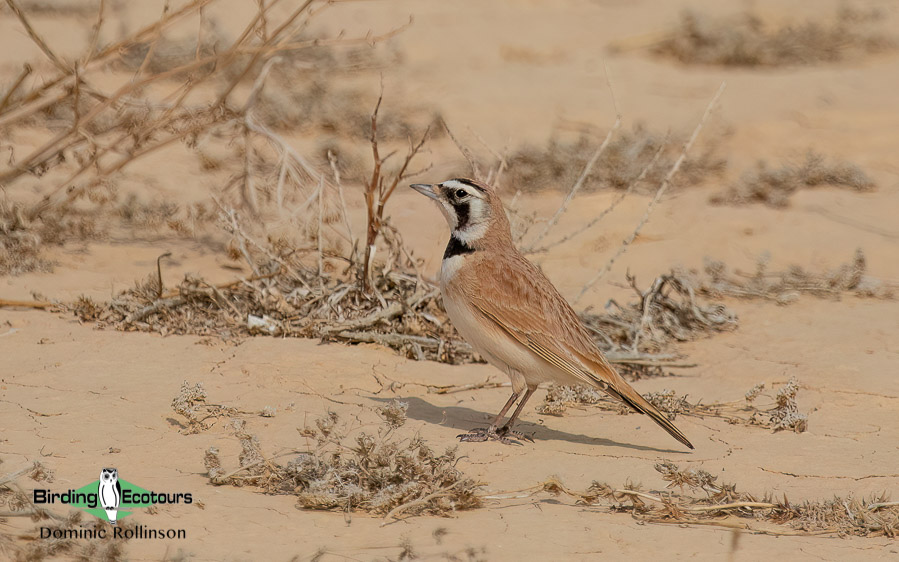 Temminck’s Lark is one of Morocco’s most striking lark species and one of many we will look for during the tour.
Its position at the northwesternmost tip of Africa makes Morocco a gateway between the continent and Europe. It acts as a key bottleneck in the African-Eurasian Flyway, funneling millions of migratory birds through the country every spring as they head to their European breeding grounds, and again in the fall as they return to their wintering areas in Africa. Morocco is an incredibly varied country to explore, shaped by the dramatic spine of the Atlas Mountains and the vast expanse of the Sahara Desert. From Mediterranean scrub and oak woodlands to snow-dusted alpine slopes, rocky steppe plains, lush oases, and rich coastal wetlands, the range of habitats is impressive. This in turn supports an exceptional number of bird species, including North African endemics such as Barbary Partridge, African Houbara, Moussier’s Redstart, and Atlas Wheatear, desert specialists like Egyptian Nightjar and Spotted Sandgrouse, and beautiful migrants such as European Roller, and Blue-cheeked Bee-eater.
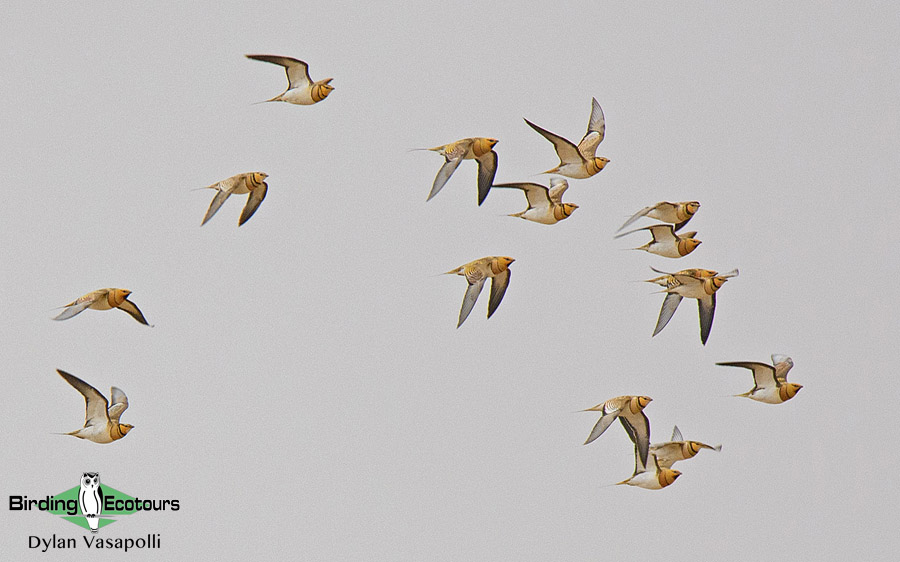 We will look for desert specialists, such as these Pin-tailed Sandgrouse.
We begin our tour by heading to the breathtaking snow-capped High Atlas Mountains, where we target species endemic to the Maghreb region of northwestern Africa. Key birds here include Barbary Partridge, Levaillant’s Woodpecker, Maghreb Magpie, African Blue Tit, and Atlas Wheatear. From here, we cross the dramatic Tizi-n-Tichka Pass, stopping to search for Tristram’s Warbler, another Maghreb endemic, in the juniper forests.
Descending into the drier foothills, we explore the famed Tagdilt Track for desert specialties such as Crowned Sandgrouse and a number of wheatears and larks, including Thick-billed Lark and the gorgeous Red-rumped Wheatear. We have a good chance of encountering the impressive Pharaoh Eagle-Owl in nearby canyons, along with migrants moving north such as Eurasian Stone-curlew, Woodchat Shrike, Western Subalpine Warbler, and Common Nightingale. We will also seek the elusive Streaked Scrub Warbler, against the backdrop of the towering Todra Gorge. Heading north to the Zaida Plain, we target the rare and declining Dupont’s Lark, as well as desert passerines such as Moussier’s Redstart and Desert Wheatear.
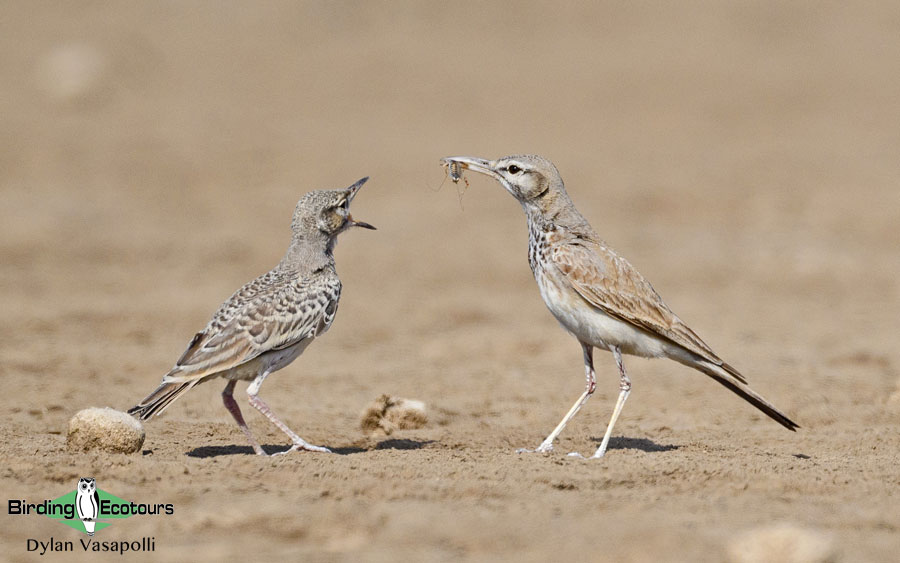 Greater Hoopoe-Lark is a highly sought-after and tough target in the desert.
As we move deeper into the desert, we stay in a beautiful traditional kasbah as our base to explore the Sahara Desert. Here some special birds become possible, including Spotted Sandgrouse, Desert Sparrow, Greater Hoopoe-Lark, Thick-billed Lark, Bar-tailed Lark and, with luck, the increasingly rare African Houbara, a bustard which has declined rapidly due to hunting pressure. We will also target other exciting species such as Egyptian Nightjar, multiple sandgrouse species, Cream-colored Courser, Pharaoh Eagle-Owl, and much more. Migrants often fill the hotel gardens, including Western Orphean Warbler, Eurasian Wryneck, and Bluethroat.
Crossing the Anti-Atlas to Ouarzazate, we stop at a productive wetland, where anything can turn up among the huge numbers of wildfowl, shorebirds, gulls, and raptors, but top targets are Marbled Duck, Greater Flamingo, and Cream-colored Courser. Continuing west through the Souss Valley, the haunt of Rufous-tailed Scrub Robin, we pause to enjoy the beautiful historic town of Taroudant. After our fill of desert birding, we reach the Atlantic coast and spend three nights in Agadir, using this as a base to explore superb coastal estuaries, rivers, and waterbodies. Here we search for key species including Marbled Duck, Audouin’s Gull, Baillon’s Crake, Little Crake, and Great Spotted Cuckoo. Our primary target in this area is the fascinating and Endangered (BirdLife International) Northern Bald Ibis, one of the world’s rarest and most distinctive birds.
Finally, we head back inland via the Atlas Mountains and arrive in Marrakech for one final night. Upon arrival we have the option of enjoying the historic old quarter of Marrakech and the famous Jemaa-el-Fna square as we wrap up what is sure to have been a fantastic bird tour.
You might be interested to follow the migrants and extend your stay in this part of the world by joining our Birding Tour Spain: Spring Birding Extravaganza tour, which follows this exciting Morocco tour.
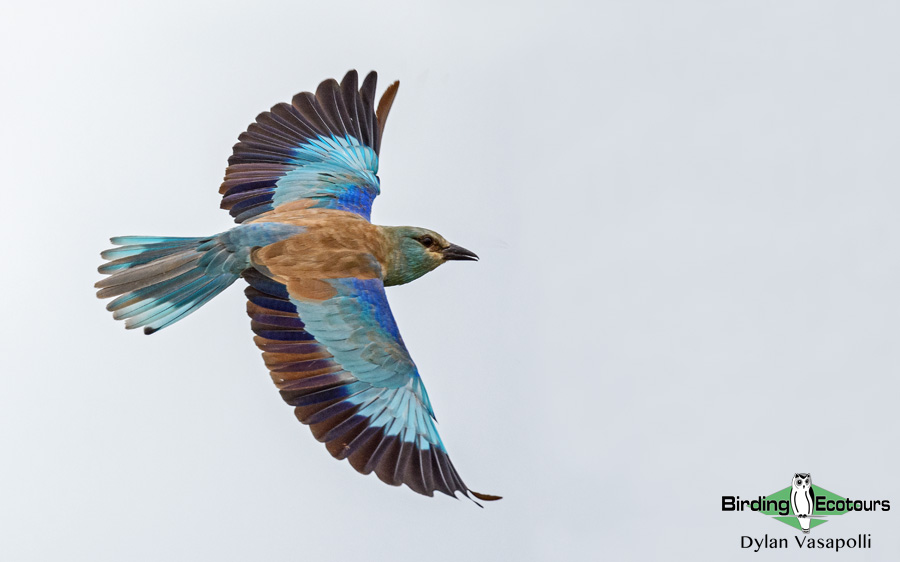 Several of the migrants we will look for offer something of a blast of color, such as this gorgeous European Roller.
Itinerary (15 days/14 nights)
Day 1. Arrival in Marrakesh
You will be met at Marrakesh Menara Airport by your experienced guides (a Birding Ecotours tour leader will accompany this tour with our excellent Moroccan local guide), and you will be transferred to your comfortable hotel for the night. This will be a great opportunity to relax after your journey to Morocco before the birding starts the next day. In the evening we will meet to have a group welcome meal and discuss the exciting tour ahead. Marrakesh is a fascinating city, and we recommend an early arrival should you want to explore its medieval city, mosques, souks, and palaces. We can help you with any extra activities and accommodation.
Overnight: Hotel El Kenzi Rose Garden, or similar, Marrakesh
Day 2. Birding the High Atlas Mountains and Oukaimeden
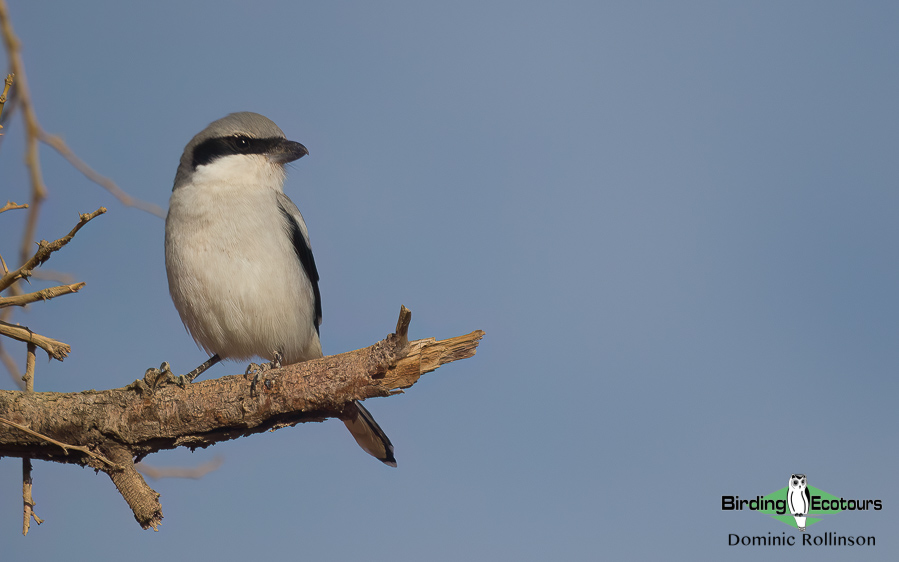
After a traditional breakfast, where the sound of Pallid Swift and Little Swift screeching overhead may greet us, we will drive up into the High Atlas Mountains and visit Oukaimeden at 8,530 feet (2,600 meters), which lies on the edge of the Parc National de Toubkal. This stunning area in the High Atlas Mountains is a popular ski resort, but it is also a fantastic area for birding. As we drive by the cultivated fields on our way into the mountains, we should see some of the region’s specials, such as Maghreb Magpie, African Blue Tit, the charismatic Moussier’s Redstart, and House Bunting, plus Little Owl, Great Grey Shrike (mostly being the algeriensis subspecies, ‘Sahara Grey Shrike’), Sardinian Warbler, Spotless Starling, and White-throated Dipper.
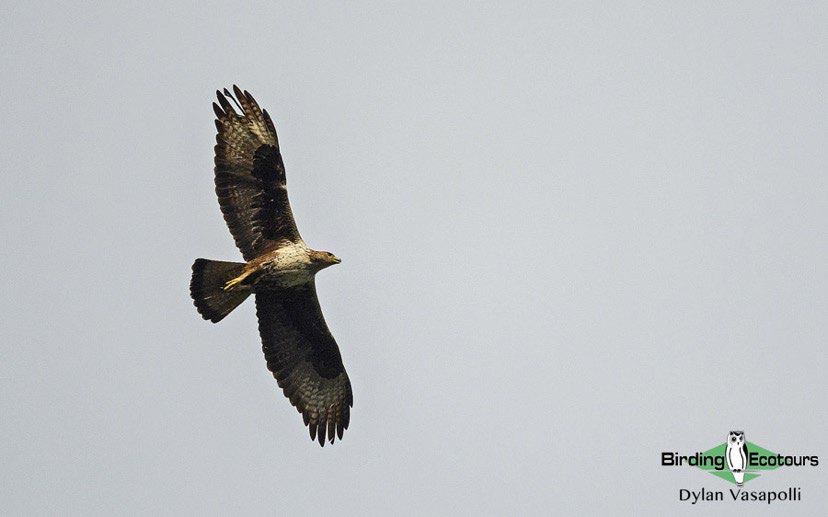 We hope to see several raptors on this tour including the impressive Bonelli’s Eagle.
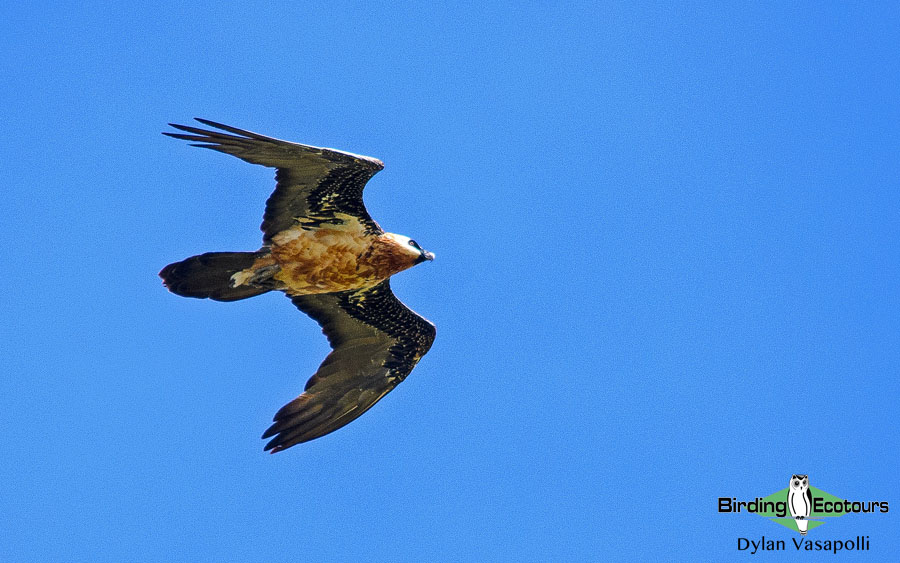
As we gain altitude, we will search the cedar and pine forests for the regional endemic Levaillant’s Woodpecker, while among the rocky slopes we hope to find the striking Atlas Wheatear and Black Wheatear. When we reach the ski resort area at Oukaimeden, we will check the snowline for the handsome Crimson-winged Finch. The mountains offer good opportunities for seeing a number of raptor species, including majestic Bearded Vulture, Short-toed Snake Eagle, Golden Eagle, and Montagu’s Harrier, and songbirds we will hope to see include Red-billed Chough, Alpine Chough, Horned (Shore) Lark, Rufous-tailed Scrub Robin, Blue Rock Thrush, Rock Sparrow, Water Pipit, African Chaffinch (a recent split from Eurasian Chaffinch), and Red (Common) Crossbill. It is sure to be a thoroughly exciting start to our Morocco bird tour.
Overnight: Hotel El Kenzi Rose Garden, or similar, Marrakesh
Day 3. Birding the High Atlas Mountains to the foothills
From the flat plains of Marrakesh, we turn back uphill, and drive to Boumalne du Dades via the famous Tizi-n-Tichka Pass at 7,414 feet (2,260 meters), which is a spectacular drive and is sure to be an enjoyable experience. At the pass we will try for Tristram’s Warbler, another regional endemic. This species has very specific habitat requirements away from its wintering grounds and it is not always an easy bird to find, but we are working with great local guides that understand this species and will put in the effort required. As the road climbs into the hills, we should start to see raptors such as Bonelli’s Eagle and Long-legged Buzzard, and hirundines like Eurasian Crag Martin, Western House Martin, European Red-rumped Swallow, along with Eurasian Hoopoe, Woodchat Shrike, and Thekla’s Lark.
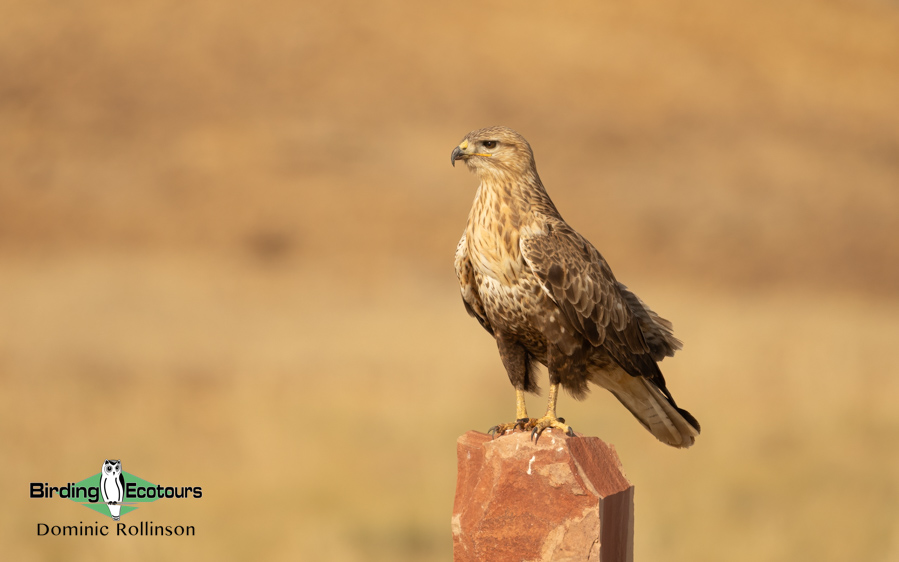 Long-legged Buzzard is another raptor species to keep an eye out for in Morocco.
Before reaching Boumalne du Dades we will stop in Amerzgane to look for the rare Maghreb Wheatear. This area is brilliant for a number of migratory songbirds, and we hope to find Woodchat Shrike, Eurasian Blackcap, Western Subalpine Warbler, Common Whitethroat, Common Nightingale, Common Redstart, Western Yellow Wagtail, and many more.
Overnight: Hotel Ksar Sultan Dades, or similar, Boumalne du Dades
Day 4. Birding the Tagdilt Track
With an early start, we will head to the famous Tagdilt Track. This is without doubt one of the top birding sites in southern Morocco. In fact, the whole area around Boumalne du Dades is sensational for birding, and here we could see a huge range of regional specials and migratory species moving north towards Europe.
While exploring the track we will keep our eyes peeled for key species like African Houbara, Black-bellied Sandgrouse, Crowned Sandgrouse, Cream-colored Courser, Desert Wheatear, Red-rumped Wheatear, White-crowned Wheatear, Trumpeter Finch, and a whole range of larks including Bar-tailed Lark, Thekla’s Lark, Temminck’s Lark, Greater Short-toed Lark, and the highly nomadic Thick-billed Lark. We will also keep our eyes peeled for Europe-bound migrants like Common Cuckoo, Eurasian Stone-curlew, Little Ringed Plover, White Stork, Common Redstart, Western Black-eared Wheatear, Northern Wheatear, and Tawny Pipit.
If the heat allows, we will dedicate most of our day to exploring this area, and in the afternoon, we will visit a rocky canyon searching for Maghreb Wheatear, Desert Lark, and our first chance of the impressive desert specialist, the Pharaoh Eagle-Owl.
Overnight: Hotel Ksar Sultan Dades, or similar, Boumalne du Dades
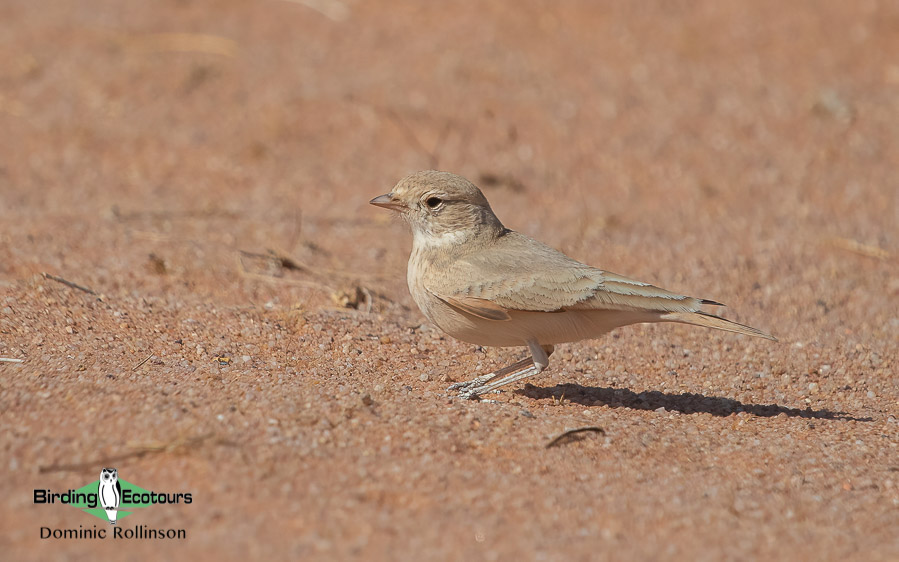 We will likely encounter several lark species on this tour, like this subtly beautiful Bar-tailed Lark.
Day 5. The Todra Gorge and Zaida
Today we will begin by visiting the Todra Gorge, just to the north of the town of Tinghir. This is another highly productive birding area with specials like Streaked Scrub Warbler, wild and native Rock Doves, as well as Eurasian Crag Martin, Tristram’s Warbler, Blue Rock Thrush, Black Wheatear, and House Bunting. The wider list of passerines here can be vast, and our visit could also give us sightings of Bar-tailed Lark, Desert Lark, Spectacled Warbler, Western Bonelli’s Warbler, White-crowned Wheatear, Western Black-eared Wheatear, Black Wheatear, and many more.
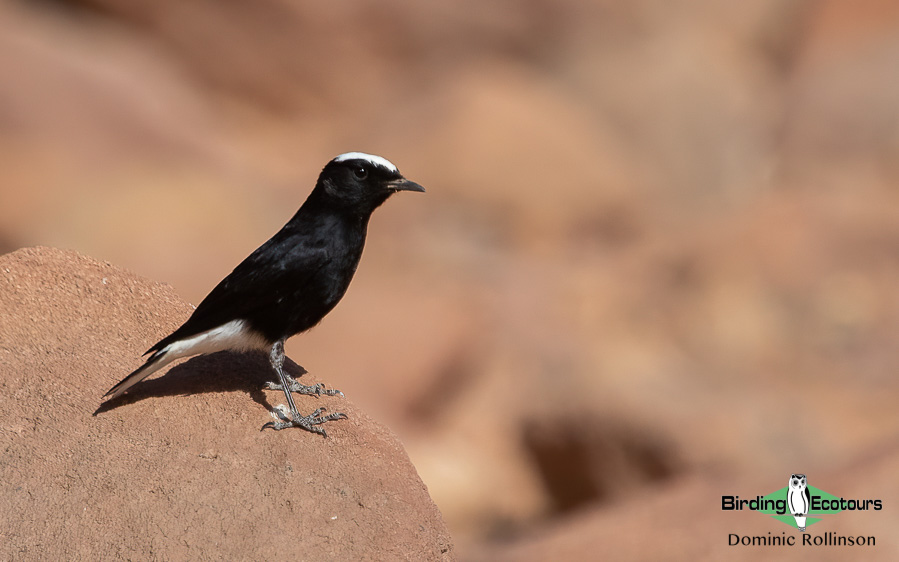 A stunning White-crowned Wheatear sits out in the open scanning the area for insect food. It is often a highly confiding species and incredibly photogenic.
The Todra Gorge is also excellent for birds of prey, with Short-toed Snake Eagle, Booted Eagle, Bonelli’s Eagle, Western Marsh Harrier, and Long-legged Buzzard all regular here. Later in the day we will travel northwards to the Zaida Plain to look for the Vulnerable (BirdLife International) Dupont’s Lark. This is a key target, as the species has seen rapid declines across many of its key breeding areas. We will also have a further chance for this species tomorrow.
Overnight: Meteorites Boulajoul Hotel, or similar, Zaida
Day 6. The Zaida Plain
Today will be an early start as we head back to the Zaida Plain to search for Dupont’s Lark. The plains are an excellent birding site with top targets including Thekla’s Lark, Temminck’s Lark, Greater Short-toed Lark, Mediterranean Short-toed Lark, Spectacled Warbler, Moussier’s Redstart, Atlas Wheatear, Desert Wheatear, Red-rumped Wheatear, and Trumpeter Finch. We will check the plains for seasonally flooded wetlands, as the water may also attract desert species to drink, with beautiful Pin-tailed Sandgrouse, Black-bellied Sandgrouse, and Crowned Sandgrouse often seen here. These wetlands offer a glimpse into the fascinating life of waterbirds in the desert, with species such as Ferruginous Duck, Little Grebe, Common Moorhen, Eurasian Coot, Little Ringed Plover, Black-tailed Godwit, and Green Sandpiper. Depending on the heat, we will spend the entire day exploring this exciting area on the edge of the Anti-Atlas Mountains.
Overnight: Meteorites Boulajoul Hotel, or similar, Zaida
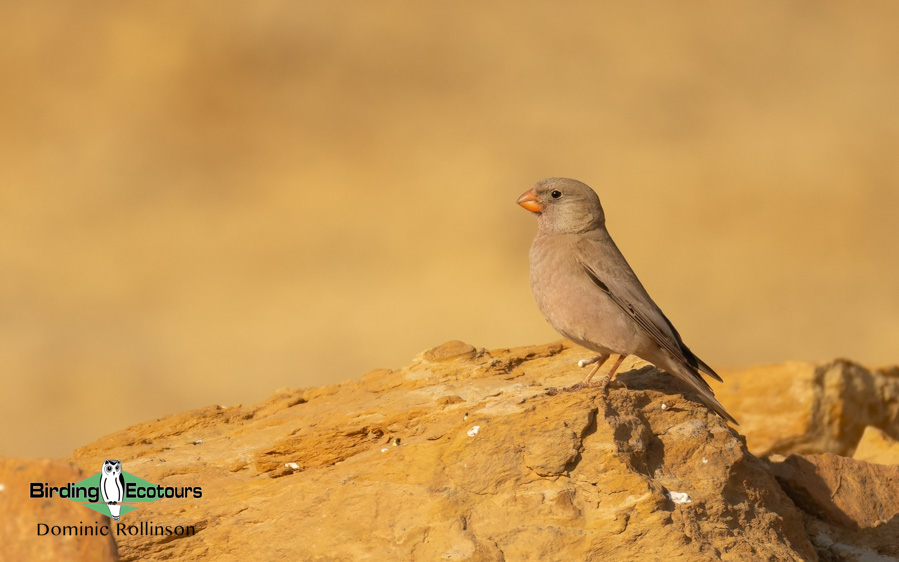 The attractive Trumpeter Finch is named after its trumpet-like song.
Day 7. Arrival in the Sahara Desert
After breakfast in our hotel, we will head south to the edge of the Sahara Desert, which is likely to be one of the many highlights of the tour! This journey will take us around five hours, but we will break up the journey with stops for birding. Along the route we may see Desert Lark, Eurasian Crag Martin, Blue Rock Thrush, White-crowned Wheatear, and many more species we may have encountered on previous days.
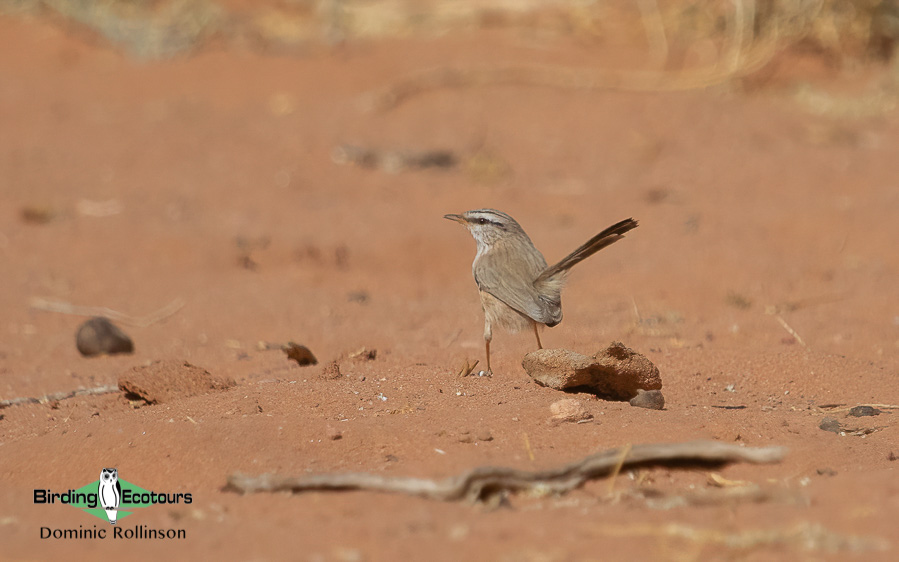
Also, on the journey we will stop at a scrubby wadi (dry river valley) to again seek out the elusive Streaked Scrub Warbler. Although widespread across North Africa, the Middle East, and Central Asia, this species is tricky to access across much of its range. While looking for this interesting species, we may also find Thick-billed Lark and Trumpeter Finch, along with many other desert species listed as targets on Days 8 and 9.
Overnight: Hotel Yasmina, or similar, Merzouga
Days 8-9. Birding the Sahara Desert
We will spend two full days in the Sahara Desert and explore the area around the town of Merzouga using comfortable 4×4 vehicles. We will explore the vast red dune known as Erg Chebbi. This is part of the largest dune system in Morocco and is a stunning backdrop to our birding here. The cafés in the area are good places to stop for a cold drink and to get incredible views of White-crowned Wheatear and Desert Sparrow. While birding among the beautiful sand dunes, we should encounter several specialist desert species, including Crowned Sandgrouse, Spotted Sandgrouse, Lanner Falcon, Brown-necked Raven, Bar-tailed Lark, Dunn’s Lark, Fulvous Babbler, African Desert Warbler, Desert Wheatear, and Trumpeter Finch. We will also have a good chance of seeing Egyptian Nightjar roosting in the day. These are well camouflaged and blend in very well with their chosen roost spot, but our local guides know where to look!
The Dayet Srij lake, at the southern edge of the dunes, can be an excellent spot for migrant shorebirds and other wetland species, including a flock of over 1,000 Greater Flamingos that often reside here – a truly spectacular sight. Shorebirds such as Black-winged Stilt, Pied Avocet, Little Ringed Plover, Kentish Plover, Green Sandpiper, Common Greenshank, Ruff, and Little Stint are all likely, as are wildfowl like Ruddy Shelduck, Tufted Duck, and the Vulnerable (BirdLife International) Marbled Duck. Overhead the beautiful bubbling calls of European Bee-eater and Blue-cheeked Bee-eater will accompany us as we bird in this remote part of the Sahara.
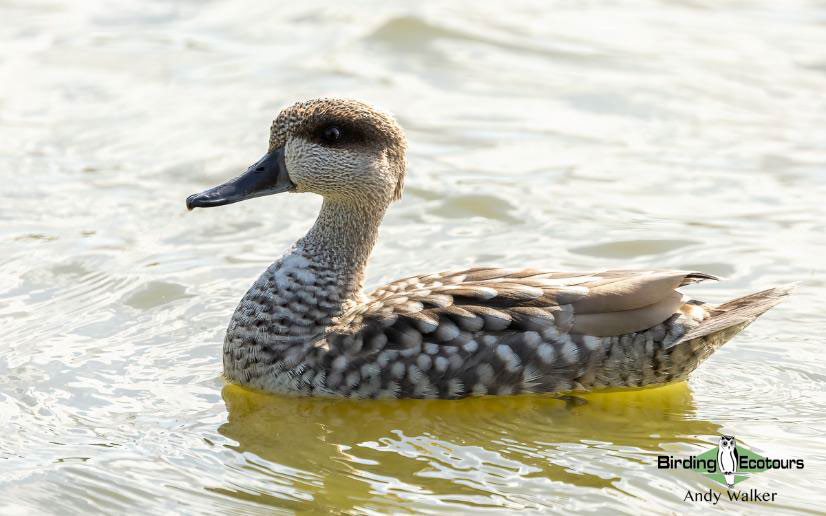 We hope to find Marbled Duck at Dayer Srij lake.
During our time in the Sahara Desert, we will stay in a delightful kasbah which has attractive gardens. These gardens are a huge draw to migrant species as they traverse this harsh desert environment, at this time of year returning from southern or West Africa back to northern Europe to breed. Typical species we may come across in the gardens here include Laughing Dove, Eurasian Hoopoe, Eurasian Wryneck, Eastern Olivaceous Warbler, Western Olivaceous Warbler, Iberian Chiffchaff, Western Subalpine Warbler, Sardinian Warbler, European Robin, Common Nightingale, European Pied Flycatcher, Black Redstart, and Tree Pipit. We may also get a visit from special desert species looking to shelter from the heat, with the striking Greater Hoopoe-Lark, Tristram’s Warbler, White-crowned Wheatear, and Desert Sparrow all possible.
Overnight (two nights): Hotel Yasmina, or similar, Merzouga
Day 10. Transfer to Ouarzazate via the Anti-Atlas Mountains
Today we will make the long drive back across central Morocco towards Ouarzazate, a stunning town and fortress in the foothills of the Anti-Atlas Mountains, famous for appearing in Game of Thrones, Gladiator, and many other films and TV shows! During our five-hour journey we will stop for birding and we should find common scrub species like Great Grey Shrike, White-crowned Wheatear, and others mentioned previously.
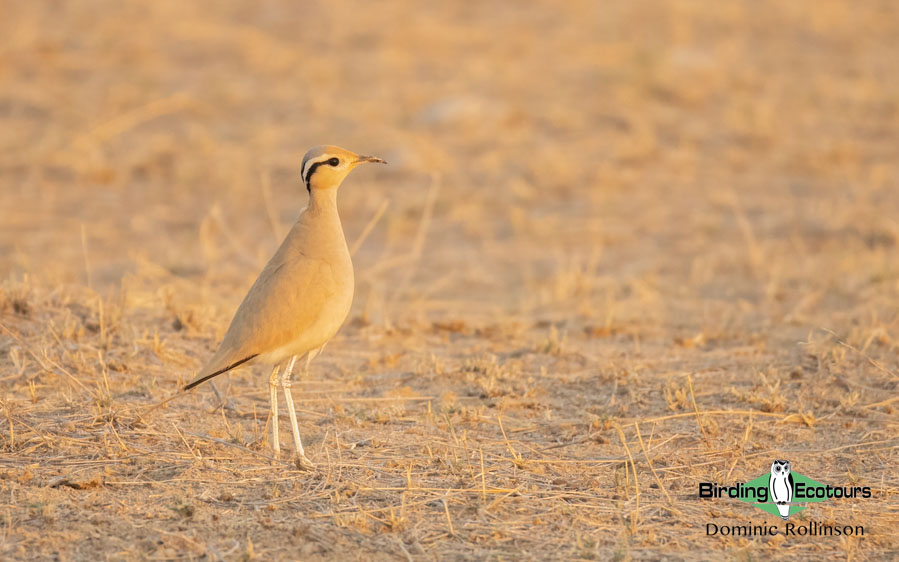 Cream-colored Courser is yet another desert special we will look for in Morocco.
Before reaching Ouarzazate, we will stop and scan the vast Barrage El Mansour Eddahbi. This is another hugely productive site with over 200 species recorded here, with the peak activity and abundance of birds being during our visit in April. One of our major targets here is the regional endemic Maghreb Lark, which we hope to find in nearby habitat. This massive lake is a fantastic spot for us to find a huge range of wildfowl, shorebirds (waders), herons, egrets, birds of prey, gulls, terns, hirundines, and passerines. Its position, combined with the attraction of water to both resident and migrant birds, means that almost anything could turn up here. To give you an idea of the variety on offer here, interesting species regularly include Ruddy Shelduck, Marbled Duck, Greater Flamingo, Purple Heron, Cream-colored Courser, Little Stint, Wood Sandpiper, Gull-billed Tern, Booted Eagle, Lesser Kestrel, Alpine Swift, European Bee-eater, Blue-cheeked Bee-eater, Thick-billed Lark, Desert Lark, Western Olivaceous Warbler, Melodious Warbler, Spectacled Warbler, Bluethroat, and Atlas Wheatear, and so much more! It is sure to be an exciting visit with so many species on the cards.
Overnight: Riad Dar Chamaa, or similar, Ouarzazate
Day 11. The Souss Valley and Agadir
Today we will continue our drive west, through beautiful scenery while passing over the Anti-Atlas Mountains and into the Souss Valley. Within the Souss Valley we will search for interesting species like Black-crowned Tchagra, Rufous-tailed Scrub Robin, Spanish Sparrow and Cirl Bunting. Migrant birds of prey are often seen along the valley with Short-toed Snake Eagle, Booted Eagle, and Montagu’s Harrier the most likely to be observed. We also have another good chance of finding the highly sought after Tristram’s Warbler.
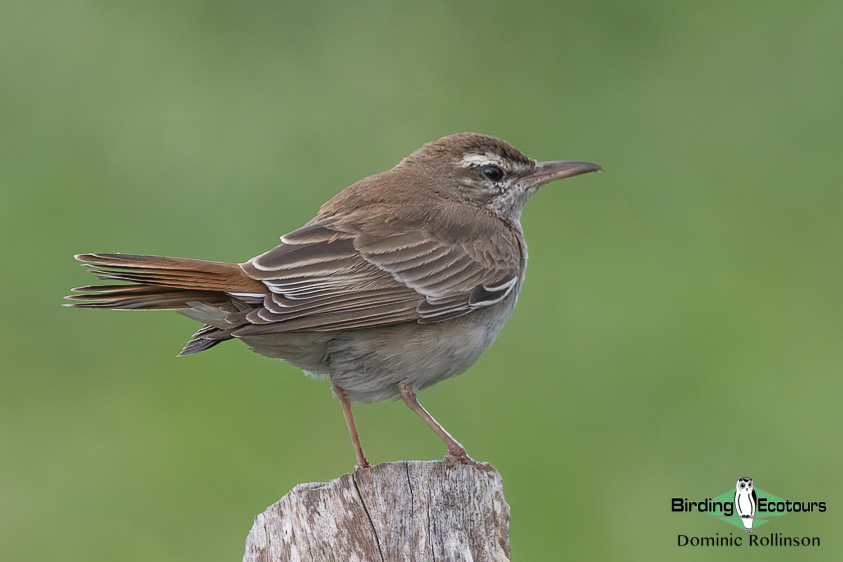 Rufous-tailed Scrub Robin is a highly prized species and one that is most common in the Souss Valley during early spring.
We stop in Taroudant, one of the most beautiful historic towns in Morocco. We will spend some time here, to both appreciate the charming walled city, and the large numbers of Little Swift and Pallid Swift which often give stunning views as they swirl around the well-preserved ramparts. Around the town we may also find exciting species like Barbary Partridge, Levaillant’s Woodpecker, Maghreb Magpie, African Blue Tit, Fulvous Babbler, Moussier’s Redstart, White-crowned Wheatear, and House Bunting. The area is also a migration hotspot and we could find any of a large number of species. The most regularly reported at the time of our visit include White Stork, Spotted Crake, European Turtle Dove, Common Cuckoo, Sedge Warbler, Western Orphean Warbler, and Spotted Flycatcher
Finally, we will reach the Atlantic coast and the city of Agadir, where we will be based for the following three nights as we explore the next wonderful area on our tour.
Overnight: Hotel Petit Palace, or similar, Agadir
Day 12. Birding Oued Massa and Oued Souss
Today we will explore the fantastic coastal wetlands of the Oued Massa National Park. This highly productive area is home to an incredible mix of resident and migrant species, with significant numbers of shorebirds (waders), wildfowl, gulls, terns, herons, egrets, birds of prey, and passerines possible. Like other areas on our tour, Oued Massa has several key target species, including Marbled Duck, and Moussier’s Redstart. Other notable species here include Garganey, Little Bittern, Glossy Ibis, Eurasian Spoonbill, Eurasian Stone-curlew, Cream-colored Courser, Kentish Plover, Slender-billed Gull, Gull-billed Tern, Caspian Tern, Great Spotted Cuckoo, Black-crowned Tchagra, Brown-throated Martin, Mediterranean Short-toed Lark, Western Olivaceous Warbler, Western Black-eared Wheatear, and much more.
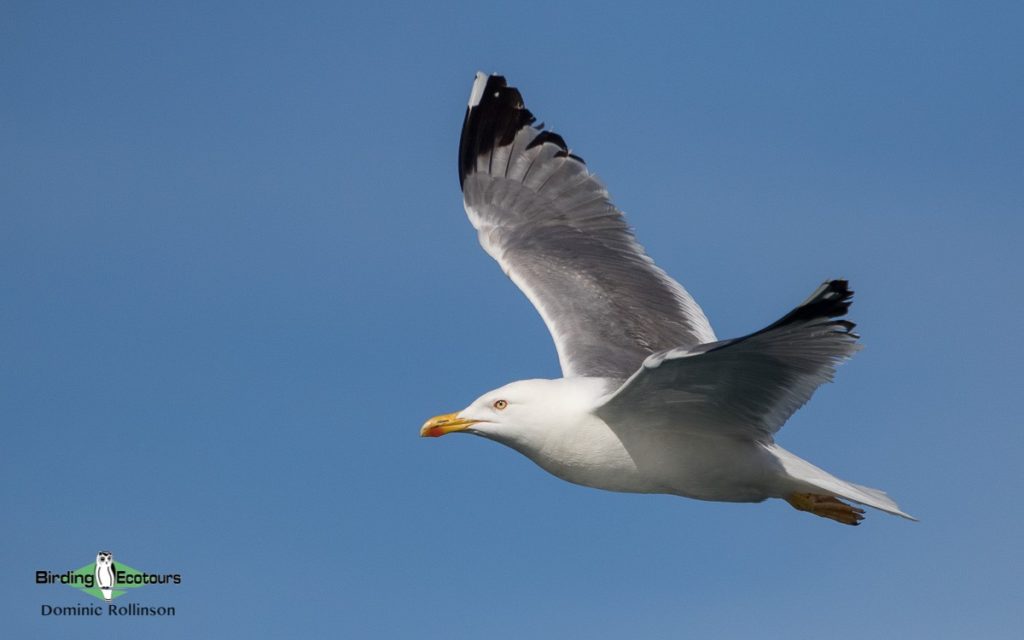 We should see large numbers of Yellow-legged Gulls at the Oued Massa River.
Later in the day we will visit the Oued Souss, the mouth of the Oued Massa River. This is a great site for shorebirds (waders), gulls, and terns, and here we should get our first sightings of the Vulnerable (BirdLife International) Audouin’s Gull. This striking species is often seen in small numbers among the much larger numbers of Lesser Black-backed Gull and Yellow-legged Gull. Other interesting species we should come across here include Marbled Duck, Ruddy Shelduck, Greater Flamingo, Collared Pratincole, Whiskered Tern, Lesser Kestrel, Maghreb Magpie, Zitting Cisticola, and Western Subalpine Warbler.
Overnight: Hotel Petit Palace, or similar, Agadir
Day 13. Birding the Atlantic coast
After breakfast we will once again explore the Atlantic coast around Agadir. Firstly, we will head to a local beach to search for Audouin’s Gull and witness the sight of hundreds of Lesser Black-backed Gulls and Yellow-legged Gulls roosting on the beach. Offshore we may find passing seabirds like Northern Gannet, Great Skua, and Balearic Shearwater.
After lunch we will head north to the remote coastal areas around Tamri, targeting the reptilian-looking Northern Bald Ibis. This Endangered (BirdLife International) species is one of the world’s rarest birds, with Morocco holding around 95% of the current wild population. While around Tamri we will explore the coastal scrub and fields in search of other attractive species like European Bee-eater, Black-crowned Tchagra, Woodchat Shrike, Moussier’s Redstart, Black Wheatear, Calandra Lark, and European Serin.
Overnight: Hotel Petit Palace, or similar, Agadir
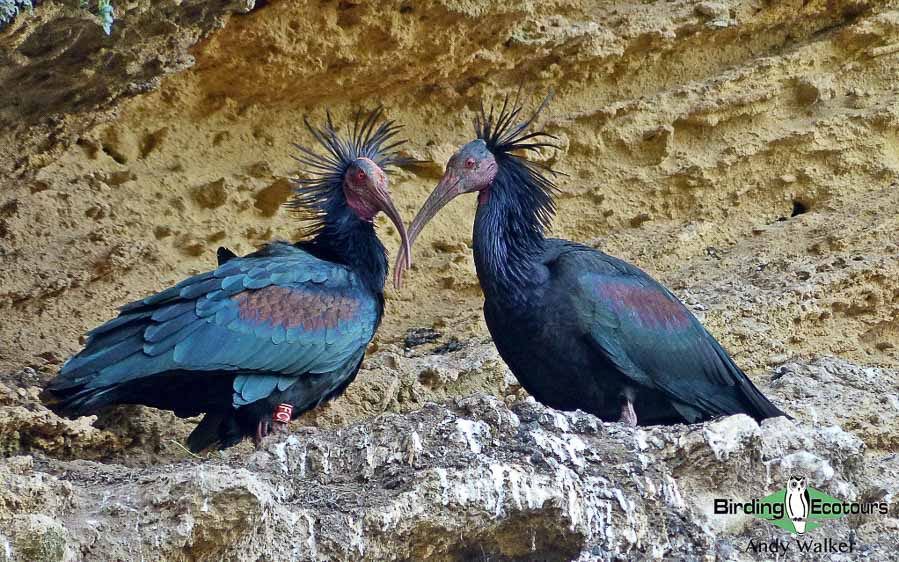 The Northern Bald Ibis is one of the world’s rarest species, and arguably one of the most strange-looking.
Day 14. Transfer from Agadir to Marrakesh
Today we will make the journey back from Agadir, across the Atlas Mountains, to Marrakesh. En route, we will make several birding stops and enjoy the stunning Moroccan landscape for one final time. In the evening we may visit the old quarter of Marrakesh, including the impressive Jemaa-el-Fna square, which is a remarkable experience for any visitor. Here we can enjoy the vast number of stalls of the souk, where you can try your hand at bartering! We will enjoy our final traditional Moroccan meal together, and the hard ask of choosing our ‘bird of the trip’.
Overnight: Hotel El Kenzi Rose Garden, or similar, Marrakesh
Day 15. Departure from Marrakesh
A non-birding day. After breakfast at our hotel, we will head to Marrakesh airport where the tour will conclude in the mid-morning. You may like to extend your stay in this part of the world by joining our Birding Tour Spain: Spring Birding Extravaganza where more great birds will await.
Overnight: Not included
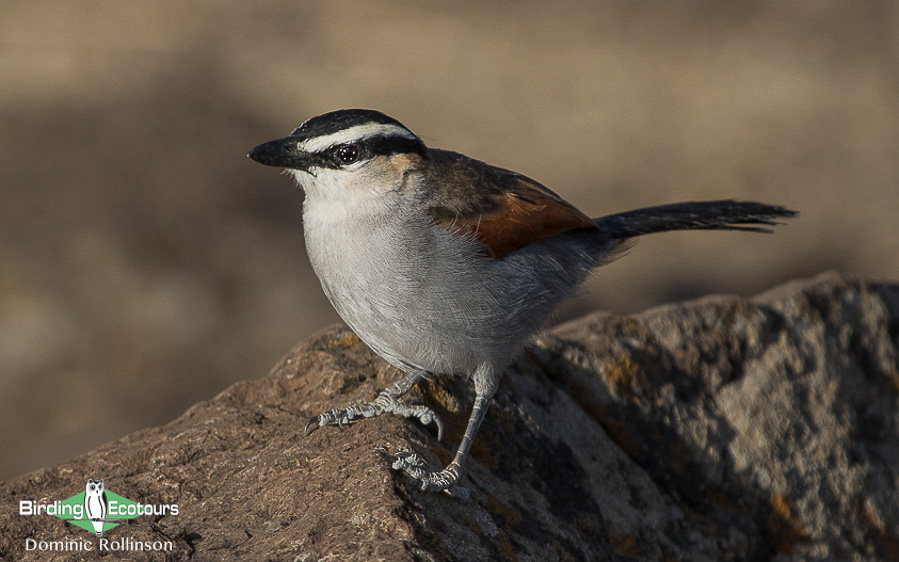
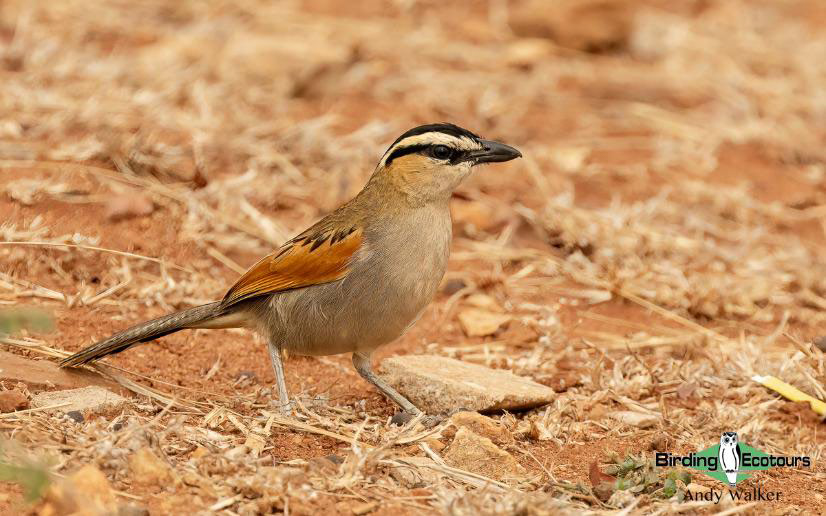 Black-crowned Tchagra is a particularly great bird for the Western Palearctic region.
Please note that the itinerary cannot be guaranteed as it is only a rough guide and can be changed (usually slightly) due to factors such as availability of accommodation, updated information on the state of accommodation, roads, or birding sites, the discretion of the guides, and other factors. In addition, we sometimes have to use a different guide from the one advertised due to tour scheduling or other factors.
Map
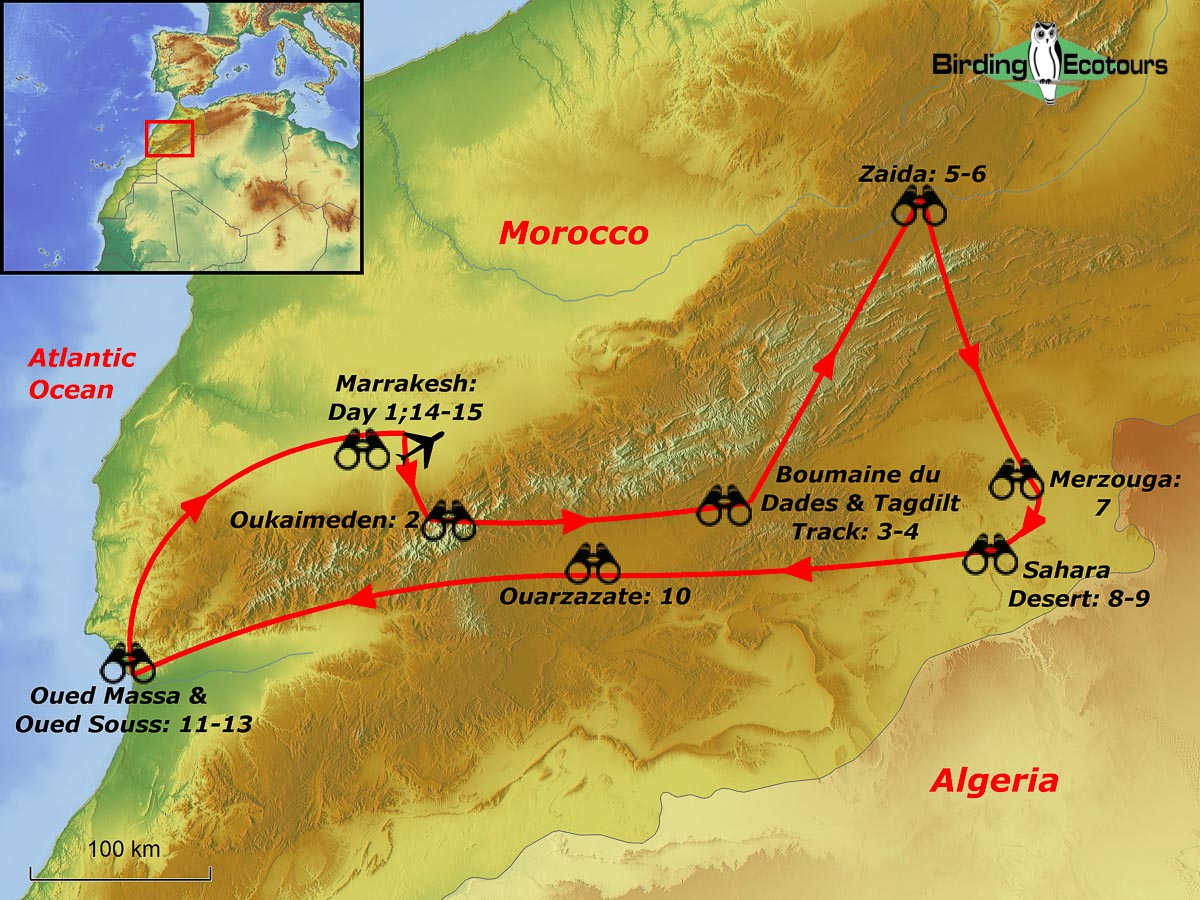
Gallery
General Information
MOROCCO: GENERAL INFORMATION
TOUR OUTLINE
On this Morocco birding tour, we visit the best birdwatching sites in the country, covering an exceptional diversity of habitats, from the High Atlas Mountains and arid desert plains to the vast dunes of the Sahara, Atlantic coastline, and productive coastal wetlands. The tour targets North African endemics and desert specialists, and is well timed in spring to enjoy the many European migrants that winter in, or pass through, Morocco on their way north.
We begin in the High Atlas Mountains, searching for key species such as Levaillant’s Woodpecker, Atlas Wheatear, and Crimson-winged Finch, before moving south through the stunning and endless desert landscapes around Boumalne du Dades and Merzouga. Here we focus on Sahara and semi-desert species including the threatened African Houbara, Crowned Sandgrouse, a superb diversity of larks and wheatears, and many palearctic migrants. The tour then continues west through the Anti-Atlas to Ouarzazate, then to the beautiful historic town of Taroudant, before heading to the Atlantic coast where wetlands and coastal scrub hold species such as Marbled Duck, Audouin’s Gull, and the remarkable Northern Bald Ibis, providing a fitting end to a highly varied spring birding tour.
DAILY ACTIVITIES, PHYSICAL REQUIREMENTS, AND TOUR PACE
The tour is run at a fairly relaxed pace overall, though in order to cover the wide range of habitats and bird species, travel is necessary and there are several one-night stays. As a result, the tour can feel fast-paced at times, although we minimize the number of single night stops where possible. There are a few substantial travel days, such as the transfer from Merzouga across central Morocco to Ouarzazate, which takes around five hours.
Our days typically begin at around 07:00. Breakfast will either be taken at the hotel before heading out birding, or as a boxed breakfast eaten in the field. Bird activity usually drops during the heat of the middle of the day, and on transfer days we will plan our transfers during this period where possible. On days where we are not transferring to another hotel, we will rest and refresh during this period, and have a nice lunch at a local restaurant. Birding generally resumes in the early or late afternoon, and we expect to finish most days at around 18:00. We hope to see the main nocturnal target species, Pharaoh Eagle-Owl and Egyptian Nightjar, at daytime roosts, so dedicated night birding should not be required.
Birding throughout the tour is a mix of roadside stops and short walks along trails or quiet roads through open desert, mountain forests, rocky valleys, wetlands, and coastal scrub. Much of the birding in Morocco takes place in open habitats, which often provides excellent opportunities for photography. Some days will be physically easy and largely vehicle-based, while on others we may walk up to around 4 miles (6.4 kilometers), usually along quiet roads or mountain trails, with frequent stops made for birding.
SPECIES RECORDING (BIRD LISTS AND ANIMAL LISTS)
Ahead of the tour we will email you a detailed daily itinerary complete with meeting/arrival instructions. We will provide you with a printed blank diary page within the itinerary document so that you can note down any names of birding sites that you may want to log. Each evening your tour leader will go through the itinerary with you to let you know any specifics to be aware of for the following day (e.g. clothes and equipment needed, breakfast time, time for leaving hotel, key target birds we will be looking for, etc.). On the first night of the tour you will be given a bird list and list of other animals possible on the tour (or a blank list to write them in as we go). We follow the latest IOC (International Ornithological Congress taxonomy) for birds and International Union for Conservation of Nature (IUCN) for all other animals recorded during the tour so all itineraries and checklists follow these taxonomies.
Each evening we will go through the daily bird and animal lists, logging all the species from the day. The listing session is optional, we realize that some of our clients aren’t fussed about the listing aspect, but others are. If you do not want to take part in the nightly bird list that is perfectly fine, but it is a useful way to remember what was seen during the day, so recommended.
PASSPORT, VISA, AND ENTRY REQUIREMENTS
Most visitors to Morocco do not require a visa for tourist stays of up to 90 days. However, entry and exit requirements can change at short notice, so it is essential to check the latest information on the official Visit Morocco website before travel. Do not assume you will be eligible for visa-free entry without confirming current regulations.
Citizens of the United States (USA), the United Kingdom (UK), Australia, and Canada can currently enter Morocco without a visa for tourism for stays of up to 90 days. Please confirm details via your own government’s advice, see here for the US, here for Canada, here for the UK, and here for Australia. Citizens of other countries should check their own government guidance and contact the nearest Moroccan embassy or consulate for up-to-date requirements.
Visa-free entry is granted provided you have:
-
A passport valid for six months beyond your arrival
-
At least one blank passport page for entry and exit stamps
-
A passport that is in good condition, as damaged passports may be refused entry
Visa-free stays cannot be extended beyond 90 days without permission. If you overstay without an approved extension, you may face fines or delays when departing Morocco. Always ensure your passport is stamped on entry, as missing entry stamps have caused difficulties for some travellers when leaving the country.
Please make sure that you bring a photocopy of your passport with you on the tour, to be kept in a different location to your original passport, in case of loss/damage. This can be kept with other important documents such as vaccine certificates, emergency contact details, and insurance documents. Digital copies of these saved on a “cloud” system can also be useful.
TRAVEL INSURANCE
As per our standard Terms and Conditions, we strongly recommend that you purchase comprehensive trip cancellation insurance to protect against unexpected events that might cause delays and interruptions to travel. Your insurance should also cover illness, medical issues, accidents, repatriation, loss of luggage or valuable items, flight delays/cancellations, and ideally medical evacuation included. Failure to purchase adequate insurance could be costly if something unexpected occurs.
HEALTH, VACCINATIONS, AND MEDICAL CONDITIONS
We recommend that you are up to date with routine vaccinations before travelling to Morocco, including measles-mumps-rubella (MMR), tetanus, diphtheria, polio, chickenpox, flu, shingles, and COVID-19. Hepatitis A is strongly recommended for all travelers, and Hepatitis B and Typhoid vaccinations would be beneficial. Rabies is present in Morocco in stray dogs, though the risk to travelers is low with precautions. Do not touch or feed stray dogs, and inform your guide to help you seek medical advice promptly if bitten or scratched. To reduce risk of insect-borne illnesses such as leishmaniasis use insect repellent and wear long sleeves and trousers, especially in the evenings. There is also a low risk of water-borne diseases such as schistosomiasis and leptospirosis, so swimming or wading in freshwater bodies should be avoided. Mild stomach upsets are not unusual, so it is sensible to carry basic medication such as anti-diarrheal tablets, just in case. Please carefully read the CDC traveler advice which contains information on required vaccinations to enter Morocco.
As per our general Terms and Conditions, we require you to notify us at the time of registering for this tour of any medical conditions that we should know about (these should include, but not be limited to, walking/mobility issues, allergies, heart conditions, diabetes, epilepsy, long-term illnesses etc.). While in Morocco we will not be far from major hospitals, located in the capital Marrakesh, and Agadir. Please make sure that you are covered with suitable medical insurance in case of an emergency while on the tour, because without insurance the cost for medical care is likely to be extremely high.
SAFETY, DANGEROUS ANIMALS, AND LOCAL CUSTOMS
Morocco is generally a safe and stable destination, with crime rates lower than the United Kingdom and United States of America. As with travel anywhere in the world, visitors should remain aware of their surroundings and take sensible precautions, particularly in busy tourist areas such as city centers, markets, and transport hubs. Petty crime, including pickpocketing and bag snatching, can occur, so please keep a close watch over personal belongings such as bags, wallets, cameras, and optics.
Although the risk is low, terrorism remains a global concern. Past incidents in Morocco have been rare, and the authorities maintain a visible security presence, particularly at hotels and tourist sites. We recommend staying alert in crowded public places and following the guidance of local authorities and your tour leaders. Demonstrations and protests can occur, especially in cities, and while most are peaceful they may disrupt travel and should be avoided if encountered. We work with experienced local guides who monitor local conditions both before and during the tour.
While encounters are uncommon, Morocco is home to several venomous scorpions and snakes, including the beautiful Desert Horned Viper, particularly in desert and semi-desert environments. Caution should be taken while out in the field. Always check footwear before putting it on, watch where you place your hands and feet, and do not touch or approach any wildlife. Sturdy walking boots are essential to provide added protection for feet and ankles, and it is important to follow your guide’s advice at all times.
Morocco is a predominantly Muslim country with conservative social customs. Visitors are expected to dress modestly in public, particularly in rural areas and towns, with shoulders and knees covered by both men and women. Alcohol is available in licensed hotels, restaurants, and bars, but drinking in public places is illegal. Photographing government buildings or local people without permission is also not permitted.
FOOD AND WATER
We recommend not drinking tap water in Morocco. An ample supply of drinking water is available throughout the tour in our vehicle, so please bring a refillable water bottle to try and reduce the amount of plastic waste generated during the tour. Ice is considered safe in high standard restaurants and hotels but should probably be avoided in rural areas or on street stalls.
Mealtimes are likely to be within normal eating hours, but these will be somewhat flexible depending on our birding/travel plans and so if you need to eat food at a specific time of day (e.g. to agree with medication you are on) you may need to bring snacks to supplement the above, such as cereal bars, protein bars, and dried fruit etc. We will not make regular stops at convenience stores, but there will be occasional opportunities to purchase items when time allows.
Dietary preferences are generally well catered for at the hotels we use and in restaurants throughout Morocco, particularly in larger towns and tourist areas. Moroccan cuisine is varied and flavorful, with meals commonly based around chicken, lamb, fresh vegetables, flatbread, rice, and fragrant spices. Traditional dishes such as tagines and couscous are staples, and on the coast there is often access to fresh seafood. Breakfast is usually simple and often includes bread, eggs, jam, fruit, juice, tea, and coffee. Lunch will either be taken at cafés and restaurants, or provided as a picnic with fresh bread, cheese, tuna, salads, and local fruit. Dinner is typically taken at our accommodation and is often a highlight, ranging from classic tagines to vegetable-rich couscous, and in more tourist-focused hotels may be served as a buffet. Vegetarian options and some Western-style dishes are usually available, making meals suitable for most tastes.
CURRENCY
The official currency of Morocco is the Moroccan Dirham (MAD) and is used for most transactions. While credit and debit cards can be used in larger restaurants, hotels, and some larger markets, many smaller shops and vendors will prefer payment in cash. Paying in local currency generally offers better value and avoids card surcharges.
It is possible to exchange or withdraw money on arrival at major international airports in Morocco, and ATMs are widely available in towns and cities. We can also advise during the tour on where and how to exchange money locally. We recommend carrying some local cash for everyday purchases, particularly when away from larger towns. Please remain vigilant when using ATMs and handling cash, especially in busy public areas.
WEATHER/CLIMATE
Morocco is located in north-west Africa, bordered by the Atlantic Ocean, the Mediterranean Sea, and the Sahara Desert. This setting, combined with the Atlas and Anti-Atlas mountain ranges and extensive arid landscapes, strongly influences the country’s climate. Spring, from March to May, is one of the best times to travel, though conditions vary greatly by region and elevation.
In March, daytime temperatures in lowland areas are often cool to mild, typically around 50 to 68°F (10 to 20°C), with cold nights, especially in desert and mountain regions where temperatures can drop close to freezing. By May, lowland daytime temperatures commonly rise to 77 to 95°F (25 to 35°C), with much stronger sun and warmer nights.
On this tour we experience a wide range of climates. In the Atlas and Anti-Atlas Mountains, cooler conditions prevail due to altitude, and in March daytime temperatures in the High Atlas can be as low as 32 to 41°F (0 to 5°C), with freezing mornings, wind, and occasional lingering snow possible. In arid and desert regions, including the edge of the Sahara Desert, conditions warm rapidly through spring, and by May daytime temperatures can reach around 95 to 104°F (35 to 40°C), while nights can still cool quickly after sunset. The tour concludes along the Atlantic coast, where temperatures are generally milder and moderated by sea breezes.
Rainfall in spring is generally low, especially in desert areas, though occasional rain or even snow may still occur in the mountains. Windy conditions are possible in both mountain and desert regions and can make temperatures feel significantly colder or hotter than expected.
ELECTRICITY AND COMMUNICATION
The power plug sockets in Morocco are Type C and Type E, which are used widely across continental Europe, including countries such as France, Germany, and the Netherlands, as well as in parts of Asia and Africa.
The standard electrical supply in Morocco is 220 volts (V) with a frequency of 50 hertz (Hz). Further details (and photos) can be found here. Adaptors are therefore likely to be required for many visitors, and in some cases a voltage converter may also be needed. Travelers should take care when using appliances designed for different voltages or frequencies. All hotels used on this tour have Wi-Fi, and mobile phone coverage is generally very good throughout Morocco.
TRANSPORTATION AND LUGGAGE
Transport during the tour will depend on the group size. For larger groups, a comfortable minibus will be used as the main tour vehicle, with 4×4 vehicles used for accessing remote sites such as the Sahara Desert. For smaller groups, we are likely to use one or several 4×4 vehicles throughout the tour, depending on group size. Please pack as lightly as possible for this tour, bearing in mind that you will be travelling with all your luggage on transfer days. A medium-sized, soft-sided and robust duffle bag is likely to be the best option for both the tour vehicles. You will be expected to load and unload your own bags as we move between locations during the tour.
ACCOMMODATION
We use good-quality hotels throughout our time in Morocco, and many of these are beautiful authentic Riad hotels. These are comfortable, modern, and well accustomed to international tourists, and importantly, they are well located for access to birding areas. All accommodations have private en-suite bathrooms with hot water, 24-hour electricity, Wi-Fi, and air conditioning. Laundry services are available throughout.
We use “standard” rooms, as is typical for most group birding tours globally, and these are deemed sufficient for most participants. If you would like to upgrade to a higher standard of room, such as a “luxury” option, this may be possible in some locations depending on availability. Please note there will be an extra charge for room upgrades, and please contact us as early as possible to discuss options.
WHAT TO BRING:
Clothing
In Morocco in spring, weather conditions can vary greatly, so layered clothing is recommended. Lightweight, breathable birding clothes in muted colors work well for warmer days, particularly in lowland and desert areas, while sun protection such as a wide-brimmed hat, sunglasses, and sunscreen is essential. Early mornings and evenings can be cold, especially in the Atlas Mountains and desert regions, so packing warm layers, including a fleece or sweater, is important.
Long trousers are useful not only for warmth during cooler periods but also for protection against sun and insects. Rain is generally uncommon in Morocco during spring, though occasional showers, and even snow in the mountains, are possible, so a lightweight, packable rain or windproof jacket is advisable. Sturdy walking shoes or lightweight hiking boots are best for birding on uneven ground, while sandals or slip-on shoes can be useful in the evenings or when visiting traditional restaurants.
Equipment
Binoculars are essential for all birding, and a camera is highly recommended. Your guide will carry a telescope throughout the tour, though given the amount of open terrain you may wish to bring your own if you prefer.
If you are unsteady on your feet or concerned about uneven or rocky ground, a walking stick or hiking pole can be useful, particularly when birding in the Atlas Mountains. Due to dusty and sandy conditions, especially in desert regions, a small hand towel or washcloth is useful for cleaning optics and other equipment in the field. Carrying a small personal first aid kit is also advisable for minor cuts, blisters, and basic medications, including remedies for mild stomach upsets.
FIELD GUIDES
The Collins Bird Guide (Svensson, Mullarney, and Zetterström, 2023) is by far the best field guide for Morocco and the wider Western Palearctic. It is widely regarded as the standard reference for bird identification in Europe, North Africa, and the Middle East, and covers all species likely to be encountered on this tour. The guide features exceptionally clear and detailed illustrations, showing multiple plumages and flight views, with concise text and distribution maps placed alongside the plates, making it very effective for use in the field. The main drawback is its size and weight, as it covers a very large region and can be cumbersome to carry in the field. However, the Collins Bird Guide is also available as a mobile app, which many will prefer as it provides the same high-quality illustrations and information without the need to carry the physical book.
The Field Guide to Mammals of Europe, North Africa and the Middle East (Aulagnier, Haffner, Mitchell-Jones, Moutou, and Zima, 2025) is an excellent reference for anyone interested in the mammals encountered on this tour. It provides clear and authoritative species accounts covering identification, habitat, behavior, and distribution, supported by high-quality illustrations and detailed range maps. Due to its comprehensive coverage and size, it is best regarded as a reference guide rather than a field guide to carry while birding, and is ideal for use in the vehicle or for evening study.
Amphibians and Reptiles of Morocco (Martínez del Mármol, Harris, Geniez, de Pous, and Salvi, 2019) is the most comprehensive guide available to Morocco’s diverse herpetofauna. It covers all amphibian and terrestrial reptile species recorded in the country, with detailed identification information, high-quality photographs, distribution maps, and notes on habitat, biology, and taxonomy. The size, level of detail, and cost makes this book a specialist reference guide rather than a field guide.
USEFUL APPS AND WEBSITE RESOURCES
Merlin – an app that can help you identify birds by sight (from photos) and sound (from recordings) and is a useful tool to aid bird identification. The app is being expanded all the time with new data and regional information so is worth keeping an eye on. We recommend downloading the Middle East pack for this tour.
eBird – there is a wealth of information contained on this website and the mobile app is now excellent and useful too. Photo, video, and sound galleries are available for practically every species in the world through The Cornell Lab of Ornithology’s Macaulay Library.
Aves Vox – a good app that enables the downloading of bird songs and calls from the xeno-canto website onto your cell phone.
IOC World Bird List – this website contains all the latest details on the world of global bird taxonomy. You can read about newly described species, splits (creation of a new species) and lumps (deletion of a species) of existing species, and plenty of other important information.
Birds of the world – a brilliant website that contains information for all global bird species, with information on identification, distribution, habitat, behavior and more. While the site is less useful for species identification than a field guide, it provides a detailed overview alongside photographs, maps, videos and audio recordings.